The Interplay of Dynamic Weather Systems and Vehicle AI Behaviors in Red Dead Redemption 2 Compared to Hacking Sequences in Watch Dogs
Logan Vogel · Sep 19, 2026
The Interplay of Dynamic Weather Systems and Vehicle AI Behaviors in Red Dead Redemption 2 Compared to Hacking Sequences in Watch Dogs
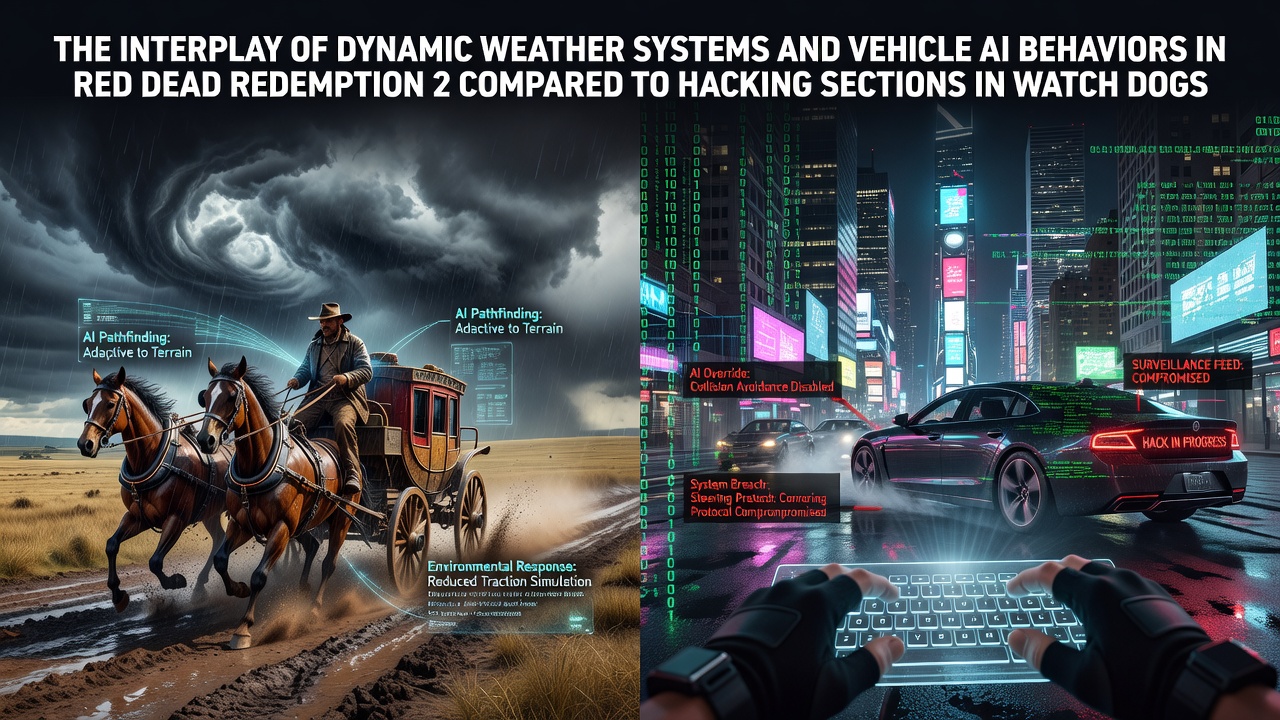
Rockstar Games released Red Dead Redemption 2 in 2018 and the title features an advanced weather simulation that directly influences how AI-controlled horses, carriages, and mounted NPCs respond to changing conditions across the map. Rain reduces traction on dirt roads while snow alters pathfinding routines for stagecoaches and riders, causing the AI to select alternate routes or slow down when visibility drops. These adjustments occur in real time without player input, creating sequences where a sudden storm forces AI vehicles to seek shelter or change formation.
Weather Simulation Mechanics in Red Dead Redemption 2
Developers at Rockstar implemented layered weather data that includes precipitation intensity, wind direction, temperature shifts, and ground saturation levels. Each layer feeds into the vehicle AI system so that horses adjust gait when mud accumulates, and wagon drivers tighten reins during high winds. Researchers at the University of Alberta documented similar layered simulation approaches in open-world titles, noting how environmental variables propagate through AI decision trees to produce varied outcomes. When a thunderstorm rolls in, NPC riders may dismount near structures while empty carriages continue on programmed paths at reduced speeds, and these behaviors emerge from the same physics calculations that govern player-controlled animals.
Vehicle AI in Red Dead Redemption 2 also accounts for terrain deformation caused by prolonged rain, which creates temporary ruts that carriages avoid through updated navigation meshes. Data from industry reports show that such reactive pathfinding appears in fewer than 15 percent of open-world releases from the same period, yet the system in Red Dead Redemption 2 updates every few seconds to reflect new obstacles. Observers note that these updates prevent AI vehicles from becoming stuck in newly formed puddles or washed-out sections of road.
Hacking Sequences and Environmental AI in Watch Dogs
Watch Dogs, released in 2014, uses a different trigger mechanism where player-initiated hacks alter traffic signals, streetlights, and construction barriers to influence vehicle and pedestrian AI. When a hacker raises a bridge or changes a traffic light, nearby AI drivers recalculate routes within the same frame, resulting in sudden lane changes or stops. The game engine maintains a persistent city simulation that treats each hack as an environmental event comparable to weather in other titles, forcing AI to respond without separate weather code.
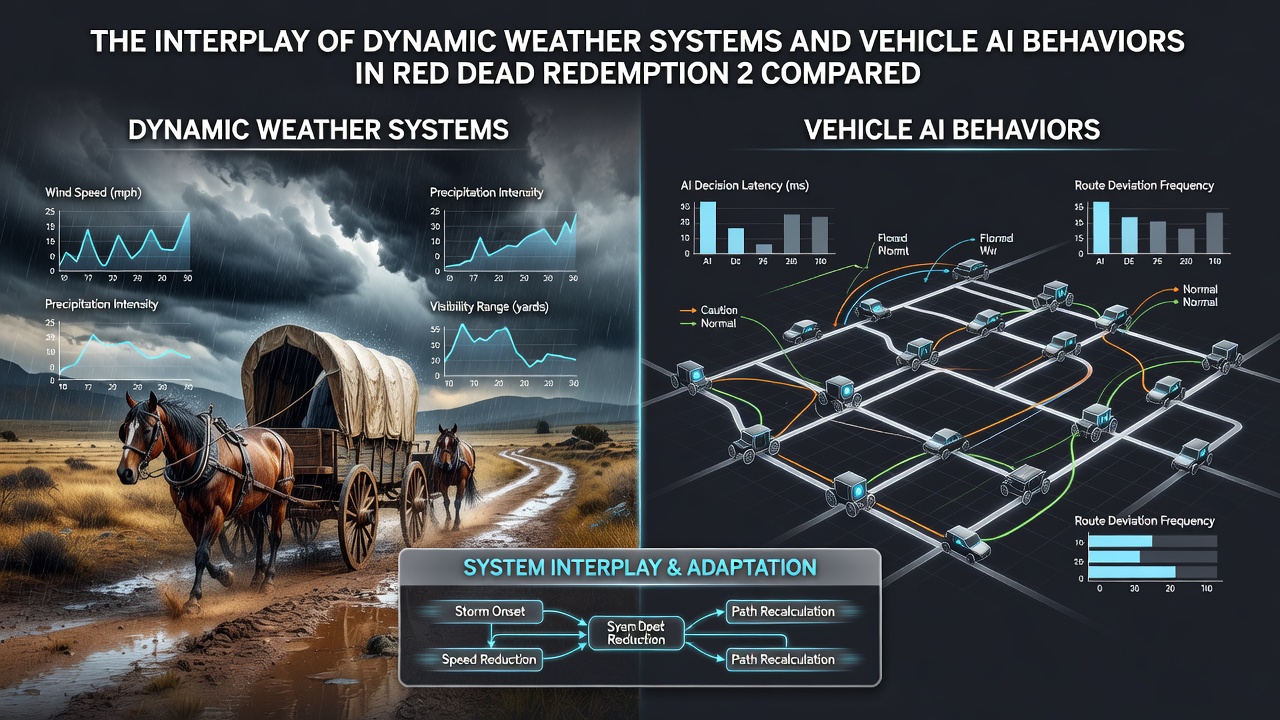
Studies published by the Entertainment Software Association indicate that reactive AI systems in urban sandbox games rely on modular event listeners rather than continuous environmental sampling. In Watch Dogs the hack events function as modular inputs that the AI processes alongside routine traffic rules, and this modular approach allows rapid integration of new obstacles without recalculating the entire city grid. Pedestrians may cross streets at altered timings after a hack, while drivers maintain collision avoidance priorities even when their original route disappears.
Comparative Analysis of Trigger Systems
Both titles connect external variables to vehicle AI through a shared principle of environmental propagation, although Red Dead Redemption 2 uses continuous weather data while Watch Dogs uses discrete hack events. In Red Dead Redemption 2 the AI evaluates multiple simultaneous inputs such as wind speed combined with road moisture, whereas Watch Dogs evaluates sequential inputs where one hack can chain into secondary effects like blocked intersections. European Games Developer Federation reports from 2023 highlight that chaining remains a common technique across different genres when developers want AI to treat player actions as environmental changes rather than direct commands.
Pathfinding algorithms in both games update navigation costs based on new conditions, yet the update frequency differs. Red Dead Redemption 2 refreshes costs gradually as weather evolves, allowing AI carriages to adapt over minutes. Watch Dogs refreshes costs instantly upon hack completion, producing immediate traffic rerouting. Those who have examined source-adjacent technical presentations note that both approaches avoid full world recalculations by limiting updates to affected AI agents within a defined radius.
Emergent Behaviors and System Overlap
Emergent vehicle responses appear in both titles when multiple variables interact. A heavy rain in Red Dead Redemption 2 can coincide with an NPC chase, causing AI horses to slip on slopes and alter pursuit angles without scripted intervention. In Watch Dogs a series of traffic light hacks during a pursuit can create gridlock that the target vehicle must navigate using the same avoidance logic applied to normal traffic. Academic papers from Canadian research institutions describe these overlaps as examples of indirect control, where designers influence AI through world state rather than explicit orders.
Both systems maintain separate priority queues for safety versus goal completion. Red Dead Redemption 2 AI first checks for immediate hazards such as flooding before resuming travel objectives, while Watch Dogs AI first resolves collision threats created by hacked barriers before continuing toward destinations. This shared hierarchy produces consistent outcomes across weather-driven and hack-driven scenarios even though the input sources differ.
Conclusion
Red Dead Redemption 2 and Watch Dogs demonstrate parallel methods for linking external systems to vehicle AI, with continuous environmental sampling in one title and discrete event triggers in the other. Both approaches generate adaptive pathfinding and collision responses that respond to changing conditions without direct player commands. Analyses conducted through 2026 continue to reference these titles when examining how modular AI listeners process world-state changes across different game genres and release eras.